
By Dan Goodman, CEO Building 36 —

Over the years, I’ve had the opportunity to work with many HVAC leaders who understand that the market is changing faster than ever — and that they have to evolve in order to compete. One of those leaders is Jimmy Hiller, Founder and CEO of Hiller Plumbing, Heating, Cooling, & Electrical and co-founder of Praxis S-10®. He not only recognizes the changes happening in our industry, but steps up to the challenge, adapts, innovates, and shares what he learns with his peers.
Praxis S-10® brings together some of the most forward-thinking leaders in home services to share ideas, challenge assumptions, and help each other grow, so it was a real privilege to join Jimmy there this year and be part of that conversation.
What stood out to me in Jimmy’s presentation was how clearly he described the shift our industry has gone through. In the past, being a professional contractor was enough to stand out. Clean trucks, uniformed technicians, a professional website, dispatch technology, and electronic payments all helped separate strong operators from the rest. Today, those things are still essential — but they are no longer differentiators. They’re simply the price of admission.
That reality has reshaped how leaders like Jimmy think about growth.
One of the biggest issues Jimmy highlighted is customer acquisition. Contractors are now operating in a world shaped by Google search, paid ads, reviews, and constant local competition. In Jimmy’s presentation, he showed that even existing customers and club members often go back to Google just to find the contractor’s phone number or website. In one example, 41.5% of the total calls into the company from existing members — came through a Google-tracked number, contributing to a huge amount of Google spend for current customers to connect.
To me, that points to a bigger problem: too many contractors are spending money to reacquire relationships they should already own.
That is why Jimmy’s focus on club memberships and retention resonated so strongly. Memberships should create long-term relationships, predictable demand, and stability. But as Jimmy pointed out, many businesses focus on how many memberships they sell instead of how many they keep. He called this the “illusion of security” — the idea that everything looks healthy as long as the membership count is growing.
The real issue is retention.
Jimmy made the case that loyal members are more profitable, reduce acquisition costs, call you first, approve more repairs and replacements, and refer family and friends. I agree with that completely. Retention isn’t just an operational metric. It’s one of the clearest indicators of long-term business health.
He also laid out something I think every contractor needs to hear: retention problems are often self-inflicted. Missed tune-ups, poor service experiences, lack of priority service, annual renewal friction, and billing failures all chip away at trust. And Jimmy was especially clear that uncompleted tune-ups are one of the biggest retention destroyers in home services.
That’s exactly the kind of challenge we built Building36 to help solve.
How Building36 Is Supporting Jimmy’s Vision
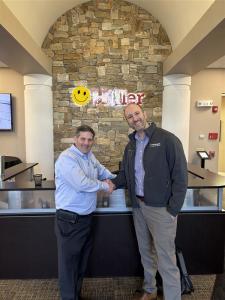 When Jimmy invited me on stage, the conversation shifted from what is broken in the traditional model to what the future can look like.
At Building36, we do not see ourselves as simply providing a smart thermostat. We see our role as helping contractors build a connected club membership — one that creates stronger customer engagement, better retention, and more predictable recurring revenue.
Yes, the branded thermostat is an important part of that model. It puts the contractor’s brand in the home every day. The bigger value is what that connected experience makes possible.
With 24/7 monitoring, contractors can identify issues earlier, respond before the homeowner even realizes there is a problem, and create a more proactive service experience. That directly addresses many of the issues Jimmy outlined.
Take uncompleted tune-ups. In a traditional model, contractors often have to chase the homeowner to schedule service and missed tune-ups are one of the leading causes of attrition. With a connected model, service alerts can notify the homeowner automatically, provide a data-based reason for the visit, and make it easy to schedule through the app. The conversation changes from “it’s time for your tune-up” to “our monitoring shows your system is due for attention, and now is the best time to take care of it before it fails.”
The same thing happens with priority service. Jimmy talked about how members can still feel like they’re waiting in line during the busiest part of the season. Connected monitoring changes that experience. When a contractor sees a problem developing and reaches out first, the homeowner feels cared for and prioritized. The service relationship becomes more valuable because it is proactive, not reactive.
To me, that is what the future of club membership looks like. It is no longer just an annual tune-up and a discount. It becomes an ongoing relationship built on visibility, responsiveness, and trust.
That is also why branding matters. When the thermostat carries the contractor’s logo and the customer interacts through a branded connected experience, the contractor has a more direct connection to that relationship. Instead of letting Google or a competitor sit between the contractor and the customer, the contractor is creating direct engagement inside the home. With Building36, that branded experience extends to the mobile app as well, giving homeowners one place to manage not only their heating and cooling system, but also other smart home devices such as door locks, cameras, lights, and garage doors. The result is that the contractor’s brand stays in front of the customer every day while delivering real, ongoing value beyond the traditional service visit.
More broadly, this is the business outcome we aim to support at Building36. Our model is designed to help contractors reduce reliance on paid customer acquisition, grow recurring revenue through smarter service plans, and build stronger long-term customer relationships. On average, our partners have seen acquisition costs reduced by 86%, service plan renewal rates boosted by 93%, and customer lifetime value increase by 5X.
What I appreciate about Jimmy’s journey is that he is not just talking about growth in terms of more leads. He is talking about protecting the customer base, improving membership value, and building a more resilient business. That is exactly how I see the opportunity as well.
The companies that win in the next era of HVAC will not just be the ones that market better. They will be the ones that retain better, engage more consistently, and create real value between service calls. That is the future Jimmy is pointing toward — and it is the future we are working to help contractors build every day.